Neuron chip
By connecting brain neurons and improving the process structure of computer chips, the computing power of the chips can achieve a qualitative leap.
By stacking a diffusion memristor and a resistor on a transistor, an integrated pulse artificial neuron can be made, which is powerful, occupies a small space (only requires one transistor), has low energy consumption, and is suitable for neural morphology computing systems. As shown in the cover image, the effective area of each neuron is approximately4 μm².
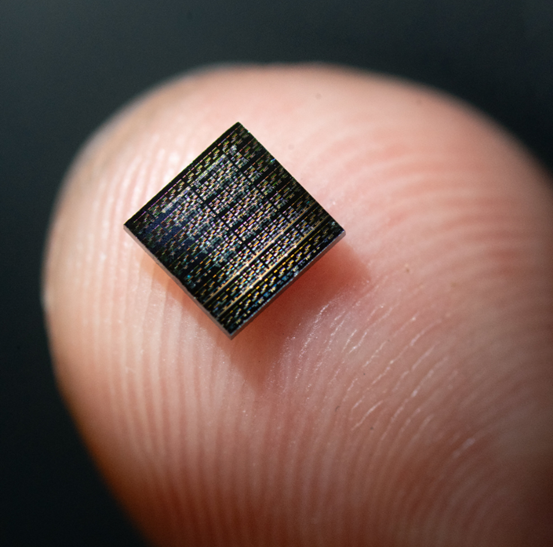
Image source: Yang's Laboratory, University of Southern California
Researchers from the Viterbi School of Engineering and the School of Advanced Computing at the University of Southern California have developed artificial neurons capable of replicating the complex electrochemical behavior of biological brain cells.
This publicationIn《Nature ElectronicsHow to translateInnovation on topFruit is a leap forward in neuromorphic computing technology. It can reduce chip size by several orders of magnitude, lower energy consumption by several orders of magnitude, and is expected to drive the development of general artificial intelligence.
Unlike traditional digital processors that only simulate neural activity or existing silicon-based neuromorphic chips, theseArtificial neuronAt the physical level, it reflects or simulates the simulated dynamics of its biological counterparts. Just as neurochemicals activate brain activity, chemicals can also be used to initiate neural morphology (neuromorphic)hardware equipmentThe calculation in. Due to their physical replication of biological processes, they are completely different from previous versions of artificial neurons that were only composed of mathematical equations.
This study was conducted by Joshua, a professor of computer and electronic engineering at the University of Southern California·Yang(Joshua Yang)The leadership's research has introduced a new type of artificial neuron based on the so-called diffusion memristor. Professor Yang also led the writing of a groundbreaking paper on artificial synapses more than a decade ago. publish《Nature ElectronicsHow to translateThis paper explores how this artificial neuron can give rise to a new type of chip that complements and enhances today's silicon-based technology. Silicon based technology provides power for almost all modern electronic devices and relies on the motion of electrons for computation.
On the contrary, the diffusion device proposed by Yang and his colleagues for constructing neurons will rely on the movement of atoms. This type of neuron can be used to manufacture new chips that operate more closely to the way our brain operates, are more energy-efficient, and have the potential to lead the way in universal technologyArtificial Intelligence(AGI)The arrival.
The working principle of chips
In biological processes, the brain uses electrical and chemical signals to drive various bodily activities. What is initially produced by neurons or nerve cellselectrical signalWhen these signals reach the gaps (synapses) at the end of neurons, they are converted into chemical signals for the transmission and processing of information. After the information is transmitted to the next neuron, some signals will be converted back into electrical signals and continue to propagate within the neuron.
Image source: Journal of Communication Engineering
Yang and his colleagues successfully simulated this physical process with high fidelity in several key aspects. Its main advantage is that their artificial neurons based on diffusion memristors only require the space of a single transistor, while traditional designs require dozens or even hundreds of transistors.
Specifically, in biological models, ions or charged particles contribute to generating electrical signals, thereby triggering neuronal activity. In the human brain, such processes rely on chemicals such as potassium, sodium, or calcium (such as ions) to drive this activity.
In this article, Professor Yang, Director of the Center of Excellence for Neuromorphic Computing at the University of Southern California, utilizes the presence of oxidantsSilver ionGenerate electrical pulses and simulate computational processes to perform activities such as motion, learning, and planning.
“Although they are not identical ions in our artificial synapses and neurons, the physical principles that control ion movement and dynamics are very similar,”He said.“Silver is easy to diffuse and can provide us with the dynamic properties we need to simulate biological systems, allowing us to achieve neuronal function with a very simple structure.”
This new type of device that can achieve a brain chip like effect is called a diffusion memristor, as it utilizes the ion movement and dynamic diffusion properties of silver.
He also added that the team chose to use ion dynamics to build an artificial intelligence system,“Because this is exactly what happens in the human brain, for good reason, and the human brain is‘Winners in Evolution’——The most efficient intelligent engine.”
“This way, the efficiency is higher,”He explained that,“It's not that our chips or computers are not powerful enough, but their efficiency is not high enough and their energy consumption is too high.”
This is particularly important considering that running large software models, such as machine learning for artificial intelligence, requires a significant amount of computing power and consumes a lot of energy.
Yang further explained that unlike the brain,“Our existing computer systems were not originally designed to handle massive amounts of data or learn autonomously with just a few examples. One way to improve energy efficiency and learning efficiency is to build artificial systems that operate according to the principles observed in the brain.”
If you pursue pure speed, then the electronics that run modern computers are undoubtedly the best choice for fast computation. But he explained:“Ions better reflect the workings of the brain than electrons. Due to the lightweight and variable nature of electronics, using them for computation enables software based learning rather than hardware based learning, which is fundamentally different from the way the brain operates.”
On the contrary, he stated,“The brain learns by moving ions across membranes, directly implementing energy-saving and adaptive learning in hardware, or more precisely, in what people may call‘wetware’Implement learning in the system.”
For example, a young child only needs to look at a few examples of handwritten digits to learn recognition, while computers typically require thousands of examples to complete the same task. However, when the human brain completes this amazing learning ability, it only consumes about20The power of watts, while today's supercomputers require megawatt level power.
This new method takes the goal of simulating natural intelligence further.
Yang pointed out that the silver used in the experiment is incompatible with traditional semiconductor manufacturing processes, and it is necessary to study other ion types to achieve similar functions.
The efficiency of these diffusion type memristors is not only reflected in energy, but also in size. Usually, a smartphone has approximately10A chip, but it contains billions of transistors or switches that control the on/off that supports computing/Close it(0and1).
Yang said:“On the contrary, through this innovative technology, we only need one transistor per neuron. We are designing and building modules that will ultimately reduce our chip size and energy consumption by several orders of magnitude,Thus, in the future, artificial intelligence can be implemented in a sustainable way, achieving similar levels of intelligence without consuming energy that we cannot afford.”
“Since we have demonstrated powerful and compact building modules——The next step in artificial synapses and neurons is to integrate them in large quantities and test to what extent we can replicate the efficiency and ability of the brain.”
Yang summarized:“What's even more exciting is that this highly reproducible system of the brain has the potential to help us discover deeper insights into the human brain.”

 CN
CN EN
EN